
Editor’s note: If you’d like to pinpoint the instant when the world entered the nuclear age, 5:29:45 a.m. Mountain War Time on 16 July 1945, is an excellent choice. That was the moment when human beings first unleashed the power of the nucleus in an immense, blinding ball of fire above a gloomy stretch of desert in the Jornada del Muerto basin in New Mexico. Emily Seyl’s Trinity: An Illustrated History of the World’s First Atomic Test (The University of Chicago Press) offers hundreds of startlingly vivid photographs of the Manhattan Project that emerged from a 20-year restoration effort. This excerpt and the accompanying photos record the massive effort to capture the awesome detonation of “the Gadget.”
aspect_ratioReprinted with permission from Trinity: An Illustrated History of the World’s First Atomic Test by Emily Seyl with contributions by Alan B. Carr, published by The University of Chicago Press. © 2026 by The University of Chicago. All rights reserved.
In the North 10,000 photography bunker, Berlyn Brixner was listening to the countdown on a loudspeaker, his head inside a turret loaded with cameras and film. He was one of the only people instructed to look toward the blast—through his welder’s glasses—ready to follow the path of the fireball as it launched into the sky. The two Mitchell movie cameras at his station would deliver the best footage to come of the Trinity test, used by Los Alamos scientists to make some of the first measurements of the effects of a nuclear explosion.
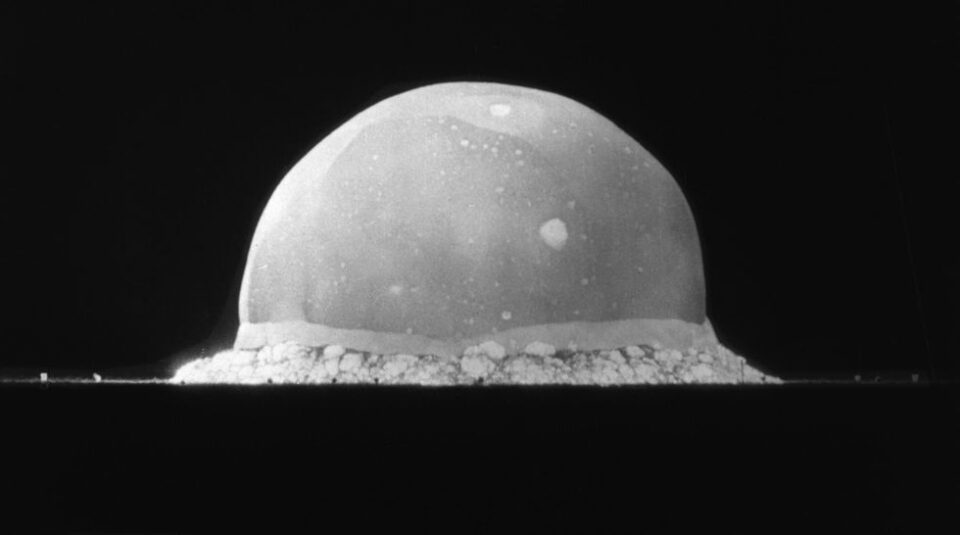
When the detonators fired, the cameras captured what Brixner could not have seen—the very first light of a violent, silent sea of energy unfurling into the basin. As 32 blocks of high explosives erupted all together, their incredible force surged inward toward the sleeping plutonium core, compressing the dense sphere of metal instantaneously from all sides and bringing its atoms impossibly close together. A carefully timed burst of neutrons sowed momentary, uncontrolled chaos, and then, as quickly as it began, the fission chain reaction ended. Footage from a high-speed Fastax camera in Brixner’s bunker, shot through a thick glass porthole, shows a translucent orb bursting through the darkness less than a hundredth of a second after detonation, as a rush of heat, light, and matter blew apart the Gadget.
When the brightness faded enough for witnesses to make out ground zero, they saw a wall of dust rise up around a brilliant, shape-shifting, multicolored ball of flames—forming a fiery cloud that shot into the sky atop a twisting stream of debris. The camera footage tells a story no less dramatic but hundreds of times more intricate, preserving the moment for scientists to return to again and again to measure and describe the behavior of the fireball and other visible effects with exacting detail. On balance, the photography effort was a huge success, despite only 11 of the 52 cameras producing satisfactory images. By arranging those cameras at intentionally staggered distances, complementary angles, and with a broad spectrum of frame rates and focal lengths, the Spectrographic and Photographic Measurements Group was able to piece together a remarkably complete picture of their subject.
On 12 July 1945, Herbert Lehr, a U.S. Army sergeant and electrical engineer assigned to Los Alamos, delivered the plutonium core to the McDonald ranch house, where the bomb was assembled. Los Alamos National Laboratory
According to the group’s leader, Julian Mack, the more than 100,000 frames that were captured still “give no idea of the brightness, or of time and space scales.” Mack attributed fortune, as much as foresight, to the photographic record that was made, especially during the earliest phase of the blast. Indeed, the explosion was several times more powerful than predicted, and the intensity of its effects overwhelmed many of the cameras and diagnostic instruments. The human observers were similarly overcome. “The shot was truly awe-inspiring,” said Norris Bradbury, the physicist who would succeed Robert Oppenheimer as director of Los Alamos. “Most experiences in life can be comprehended by prior experiences, but the atom bomb did not fit into any preconception possessed by anybody. The most startling feature was the intense light.”
Norris Bradbury, the physicist responsible for the final assembly of the Gadget, stands next to the partially assembled bomb at the top of the shot tower. The cables on the outside of the bomb would transmit the signals to trigger the synchronized detonations of conventional explosives, which would then create the inward-directed shock wave that would compress the bomb’s plutonium core. Bradbury would go on to succeed Robert Oppenheimer as director of Los Alamos on 17 October 1945.Los Alamos National Laboratory
It is a common sentiment that words and even pictures pale in comparison to the experience of the explosion. Even so, soldiers, scientists, and many other witnesses have added their firsthand accounts—often absorbing and poetic—to complement the trove of hard data collected during the test shot. They describe an intense and blinding brightness that filled the basin with daytime; an ominous, darkening cloud rearing its head in eerie silence; the wait for the invisible wave rushing out from the heart of the Gadget; and the mighty roar that arrived at last, in a thunder, and seemed never to leave. Physicist Isidor Isaac Rabi, watching from 20 miles away, remembered, “It blasted; it pounced; it bored its way right through you.”
James Chadwick, head of the British contingent of scientists who joined the Manhattan Project, later said, “Although I had lived through this moment in my imagination many times during the past few years and everything happened almost as I had pictured it, the reality was shattering.”
The blast, captured with an assortment of high-speed and motion-picture cameras, shows the fireball expanding between 25 milliseconds and 60 seconds, by which time the mushroom cloud is over 3 kilometers high.Los Alamos National Laboratory
And physicist George Kistiakowsky found himself certain that “at the end of the world—in the last millisecond of the Earth’s existence—the last human will see what we saw.”
