
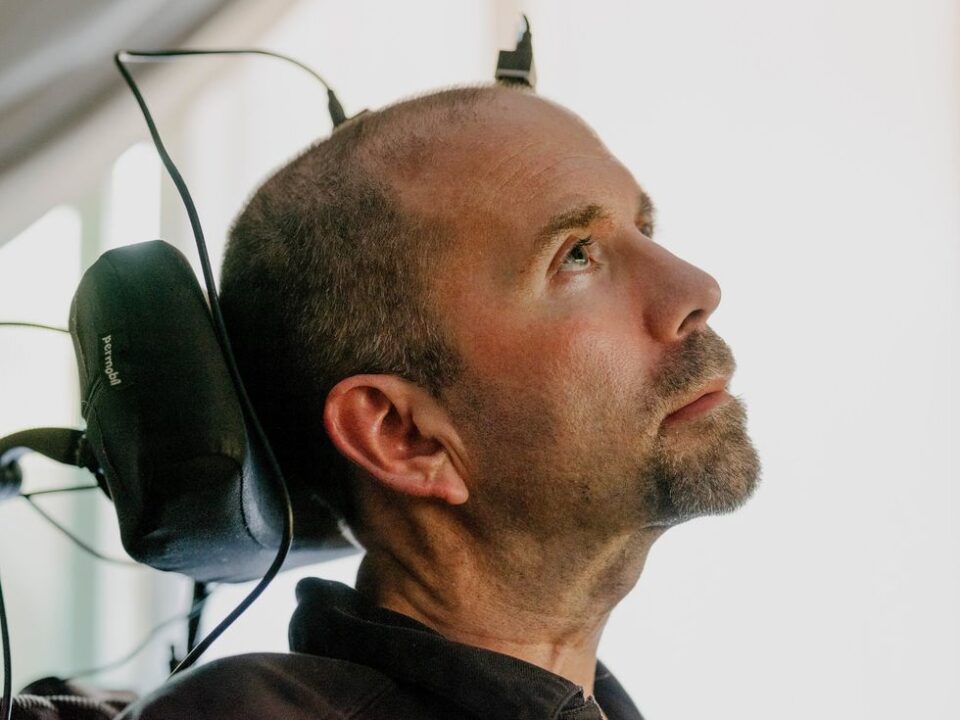
Scott Imbrie vividly remembers the first time he used a robotic arm to shake someone’s hand and felt the robotic limb as if it were his own. “I still get goosebumps when I think about that initial contact,” he says. “It’s just unexplainable.” The moment came courtesy of a brain implant: an array of electrodes that let him control a robotic arm and receive tactile sensations back to the brain.
Getting there took decades. In 1985, Imbrie had woken up in the hospital after a car accident with a broken neck and a doctor telling him he’d never use his hands or legs again. His response was an expletive, he says—and a decision. “I’m not going to allow someone to tell me what I can and can’t do.” With the determination of a head-strong 22-year-old, Imbrie gradually regained the ability to walk and some limited arm movement. Aware of how unusual his recovery was, the Illinois-native wanted to help others in similar situations and began looking for research projects related to spinal cord injuries. For decades, though, he wasn’t the right fit, until in 2020 he was finally accepted into a University of Chicago trial.
Scott Imbrie has shaken hands with a robotic arm controlled by a brain implant. The electrodes record neural signals that enable him to move the device and receive tactile feedback. Top: 60 Minutes/CBS News; Bottom: University of Chicago
Imbrie is part of a rarefied group: More people have gone to space than have received advanced brain-computer interfaces (BCI) like his. But a growing number of companies are now attempting to move the devices out of neuroscience labs and into mainstream medical care, where they could help millions of people with paralysis and other neurological conditions. Some companies even hope that BCIs will eventually become a consumer technology.
None of that will be possible without people like Imbrie. He’s a member of the BCI Pioneers Coalition, an advocacy group founded in 2018 by Ian Burkhart, the first quadriplegic to regain hand movement using a brain implant.
That life-changing experience convinced Burkhart that BCIs will make the leap from lab to real world only if users help shape the technology by sharing their perspectives on what works, what doesn’t, and how the devices fit into daily life. The coalition aims to ensure that companies, clinicians, and regulators hear directly from trial participants.
Ian Burkhart founded the BCI Pioneers Coalition to ensure that companies developing brain implants hear directly from the people using them. Left: Andrew Spear/Redux; Right: Ian Burkhart
The group also serves as a peer-support network for trial participants. That’s crucial, because despite the steady drumbeat of miraculous results from BCI trials, receiving a brain implant comes with significant risks. Surgical complications, such as bleeding or infection in the brain, are possible. Even more concerning is the potential psychological toll if the implant fails to work as expected or if life-changing improvements are eventually withdrawn.
Researchers spell this out upfront, and many are put off, says John Downey, an assistant professor of neurological surgery at the University of Chicago and the lead on Imbrie’s clinical trial. “I would say, the number of people I talk to about doing it is probably 10 to 20 times the number of people that actually end up doing it,” he says.
What Happens in a BCI Trial?
BCI pioneers arrive at their unique status via a number of paths, including spinal cord injuries, stroke-induced paralysis, and amyotrophic lateral sclerosis (ALS). The implants they receive come from Blackrock Neurotech, Neuralink, Synchron, and other companies, and are being tested for restoring limb function, controlling computers and robotic arms, and even restoring speech.
Many of the implants record signals from the motor cortex—the part of the brain that controls voluntary movements—to move external devices. Some others target the somatosensory cortex, which processes sensory signals from the body, including touch, pain, temperature, and limb position, to re-create tactile sensation.
BCI Designs Used by Today’s Pioneers
Ease of use depends heavily on the application. Restoring function to a user’s own limbs or controlling robotic arms involves the most difficult learning curve. In early sessions, participants watch a virtual arm reach for objects while they imagine or attempt the same movement. Researchers record related brain signals and use them to train “decoder” software, which translates neural activity into control signals for a robotic arm or stimulation patterns for the user’s nerves or muscles.
Paralyzed in a 2010 swimming accident, Burkhart took part in a trial conducted by Battelle Memorial Institute and Ohio State University from 2014 to 2021. His implant recorded signals from his motor cortex as he attempted to move his hand, and the system relayed those commands to electrodes in his arm that stimulated the muscles controlling his fingers.
Ian Burkhart, who is paralyzed from the chest down, received a brain implant that routed neural signals through a computer to his paralyzed muscles, enabling him to play a video game. Battelle
Getting the system to work seamlessly took time, says Burkhart, and initially required intense concentration. Eventually, he could shift his focus from each individual finger movement to the overall task, allowing him to swipe a credit card, pour from a bottle, and even play Guitar Hero.
Training a decoder is also not a one-and-done process. Systems must be regularly recalibrated to account for “neural drift”—the gradual shift in a person’s neural activity patterns over time. For complex tasks like robotic arm control, researchers may have to essentially train an entirely new decoder before each session, which can take up to an hour.
Austin Beggin says that testing a BCI is hard work, but he adds that moments like petting his dog make it all worth it. Daniel Lozada/The New York Times/Redux
Even after the system is ready, using the device can be taxing, says Austin Beggin, who was paralyzed in a swimming accident in 2015 and now participates in a Case Western Reserve University trial aimed at restoring hand movement. “The mental work of just trying to do something like shaking hands or feeding yourself is 100-fold versus you guys that don’t even think about it,” he says.
It’s also a serious time commitment. Beggin travels more than 2 hours from his home in Lima, Ohio, to Cleveland for two weeks every month to take part in experiments. All the equipment is set up in the house he stays in, and he typically works with the researchers for 3 to 4 hours a day. The majority of the experiments are not actually task-focused, he says, and instead are aimed at adjusting the control software or better understanding his neural responses to different stimuli.
But the BCI users say the hard work is worth it. Beyond the hope of restoring lost function, many feel a strong moral obligation to advance a technology that could help others. Beggin compares the pioneers to the early astronauts who laid the groundwork for the lunar landings. “We’re some of the first astronauts just to get shot up for a couple of hours and come back down to earth,” he says.
The Emotional Impact of BCIs
Speak to BCI early adopters and a pattern emerges: The biggest benefits are often more emotional than practical. Using a robotic arm to feed oneself or control a computer is clearly useful, but many pioneers say the most meaningful moments are the ones the experiment wasn’t even trying to produce. Beggin counts shaking his parents’ hands for the first time since his injury and stroking his pet dachshund as among his favorite moments. “That stuff is absolutely incredible,” he says.
Neuralink participant Alex Conley, who broke his neck in a car accident in 2021, uses his implant to control both a robotic arm and computers, enabling him to open doors, feed himself, and handle a smartphone. But he says the biggest boost has come from using computer-aided design software.
A former mechanic, Conley began using the software within days of receiving his implant to design parts that could be fabricated on a 3D printer. He has designed everything from replacement parts for his uncle’s power tools to bumpers for his brother-in-law’s truck. “I was a very big problem solver before my accident, I was able to fix people’s things,” he says. “This gives me that same little burst of joy.”
BCI user Nathan Copeland used a robotic arm to get a fist bump from then-President Barack Obama in 2016. Jim Watson/AFP/Getty Images
The outside world often underestimates those little wins, says Nathan Copeland, who holds the record for the longest functional brain implant. After breaking his neck in a car accident in 2004, he joined a University of Pittsburgh BCI trial in 2015 and has since used the device to control both computers and a robotic arm.
After he uploaded a video to Reddit of himself playing Final Fantasy XIV, one commenter criticized him for not using his device for more practical tasks. Copeland says people don’t understand that those lighthearted activities also matter. “A lot of tasks that people think are mundane or frivolous are probably the tasks that have the most impact on someone that can’t do them,” he says. “Agency and freedom of expression, I think, are the things that impact a person’s life the most.”
Nathan Copeland plays Final Fantasy XIV using his brain implant to control the game character.
When Brain Implants Become Life-Changing
This perspective resonates with Neuralink’s first user, Noland Arbaugh—paralyzed from the neck down after a swimming accident in 2016. After receiving his implant in January 2024, he was able to control a cursor within minutes of the device being switched on. A few days later, the engineers let him play the video game Civilisation VI, and the technology’s potential suddenly felt real. “I played it for 8 hours or 12 hours straight,” he says. “It made me feel so independent and so free.”
Before receiving his Neuralink implant, Noland Arbaugh used mouth-operated devices to control a computer. He says the BCI is more reliable and enables him to do many more things on his own. Rebecca Noble/The New York Times/Redux
But the technology is also providing more practical benefits. Before his implant, Arbaugh relied on a mouth-held typing stick and a mouth-controlled joystick called a quadstick, which uses sip-or-puff sensors to issue commands. But the fiddliness of this equipment required constant caregiver support. The Neuralink implant has dramatically increased the number of things he can do independently. He says he finds great value in not needing his family “to come in and help me 100 times a day.”
For Casey Harrell, the technology has been even more transformative. Diagnosed with ALS in 2020, the climate activist had just welcomed a baby daughter and was in the midst of a major campaign, pressuring a financial firm to divest from companies that had poor environmental records.
Casey Harrell was able to communicate again within 30 minutes of his BCI being switched on. The device translates his neural signals quickly enough for him to hold conversations. Ian Bates/The New York Times/Redux
“Every morning we’d wake up and there’d be a new thing he couldn’t do, a new part of his body that didn’t work,” says his wife, Levana Saxon. Most alarming was his rapid loss of speech, which, among other things, left him unable to indicate when he was in pain. Then a relative alerted him to a clinical trial at the University of California, Davis, using BCIs to restore speech. He immediately signed up.
The device, implanted in July 2023, records from the brain region that controls muscles involved in talking and translates these signals into instructions for a voice synthesizer. Within 30 minutes of it being switched on, Harrell could communicate again. “I was absolutely overwhelmed with the thought of how this would impact my life and allow me to talk to my family and friends and better interact with my daughter,” he says. “It just was so overwhelming that I began to cry.”
While earlier assistive technology limited him to short, direct commands, Harrell says the BCI is fast enough that he can hold a proper conversation, and he’s been able to resume work part-time.
What’s Holding BCI Technology Back?
BCI technology still has limits. Most trial participants using Blackrock Neurotech implants can operate their devices only in the lab because the systems rely on wired connections and racks of computer hardware. Some users, including Copeland and Harrell, have had the equipment installed at home, but they still can’t leave the house with it. “That would be a big unlock if I was able to do so,” says Harrell.
The academic nature of many trials creates additional constraints. Pressure to publish and secure funding pushes researchers to demonstrate peak performance on narrow tasks rather than build more versatile and reliable systems, says Mariska Vansteensel, who runs BCI studies at the University Medical Center Utrecht in the Netherlands. She says that investigating the technology’s limits or repeating an experiment in new patients is “less rewarded in terms of funding.”
In a clinical trial, Scott Imbrie uses a BCI to control a robotic arm, using signals from his motor cortex to make it move a block. University of Chicago
One of Imbrie’s biggest frustrations is the rapid turnover in experiments. Just as he begins to get proficient at one task, he’s asked to switch to the next task. Study designs also mean that much of the users’ time is spent on mundane tasks required to fine-tune the system.
Perhaps the biggest issue is that trials are often time-limited. That’s partly because scar tissue from the body’s immune response to the implant can gradually degrade signal quality. But constraints on funding and researcher availability can also make it impossible for users to keep using their BCIs after their trials end, even when the technology is still functional.
Ian Burkhart’s BCI enables him to grasp objects, pour from a bottle, and swipe a credit card.
Burkhart has firsthand experience. His trial was extended, but the implant was eventually removed after he got an infection. He always knew the trial would end, but it was nonetheless challenging. “It was a little bit of a tease where I got to see the capability of the restoration of function,” he says. “Now I’m just back to where I was.”
The Push to Commercialize BCIs
Progress is being made in transitioning the technology from experimental research devices to fully-fledged medical products that could help users in their everyday lives. Most academic BCI research has relied on Blackrock Neurotech’s Utah Arrays, which typically feature 96 needlelike electrodes that penetrate the brain’s surface. The implant is connected to a skull-mounted pedestal that’s wired to external hardware. But some of the newer devices are sleeker and less invasive.
Neuralink’s implant houses its electronics and rechargeable battery in a coin-size unit connected to flexible electrode threads inserted into the brain by a robotic “sewing machine.” The implant, which is roughly the size of a quarter or a euro, is mounted in a hole cut into the skull and charges and transfers data wirelessly. Synchron takes a different approach, threading a stent-like implant through blood vessels into the motor cortex. This “stentrode” connects by wire to a unit in the chest that powers the implant and transmits data wirelessly.
Rodney Gorham can use his Synchron implant to control not just a computer, but also smart devices in his home like an air conditioner, fan, and smart speaker. Rodney Decker
Neuralink’s decoder runs on a laptop, while Synchron deploys a smartphone-size signal processing unit as a wireless bridge to the user’s devices, which allows them to use their implants at home and on the move. The companies have also developed adaptive decoders that use machine learning to adjust to neural drift on the fly, reducing the need for recalibration.
Making these devices truly user-friendly will require technology that can interpret user context, says Kurt Haggstrom, Synchron’s chief commercial officer—including mood, attention levels, and environmental factors like background noise and location. This approach will require AI that analyzes neural signals alongside other data streams such as audio and visual input.
Last year, Synchron took a first step by pairing its implant with an Apple Vision Pro headset. When trial participant Rodney Gorham looked at devices such as a fan, a smart speaker, and an air conditioner, the headset overlaid a menu that enabled him to adjust the device’s settings using his implant.
Rodney Gorham uses his Synchron implant to turn on music, feed his dog, and more. Synchron BCI
Another way to reduce cognitive load is to detect high-order signals of intent in neural data rather than low-level motor commands, says Florian Solzbacher, cofounder and chief scientific officer of Blackrock Neurotech. For instance, rather than manually navigating to an email app and typing, the user could simply think about sending an email and the system would then open it with content already prepopulated, he says.
Durability may prove a thornier problem to solve, UChicago’s Downey says. Current implants last around a decade—well short of a lifelong solution. And with limited real estate in the brain, replacement is only possible once or twice, he says.
Rapid technological progress also raises difficult decisions about whether to get a BCI implant now or wait for a more advanced device. This was a major concern for Gorham’s wife, Caroline. “I was hesitant. I didn’t want him to go on the trial but maybe a future one,” she says. “It was my fear of missing out on future upgrades.”
Will Brain Implants Ever Become Consumer Tech?
Some executives have raised the prospect of BCIs eventually becoming consumer devices. Neuralink founder Elon Musk has been particularly vocal, suggesting that the company’s implants could replace smartphones, let people save and replay memories, or even achieve “symbiosis” with AI.
This kind of talk inspires mixed feelings in users. The hype brings visibility and funding, says Beggin, but could divert attention from medical users’ needs. Copeland worries that consumer branding could strip the devices of insurance coverage and that rising demand may make it harder to access qualified surgeons.
Noland Arbaugh, the first recipient of Neuralink’s BCI, says that using the implant to control a computer made him feel independent and free. Steve Craft/Guardian/eyevine/Redux
There are also concerns about how data collected by BCI companies will be handled if the devices go mainstream. As a trial participant, Arbaugh says he’s comfortable signing away his data rights to advance the technology, but he thinks stronger legal protections will be needed in the future. “Does that data still belong to Neuralink? Does it belong to each person? And can that data be sold?” he asks.
Blackrock’s Solzbacher says the company remains focused on the medical applications of the technology. But he also believes it is building a “universal interface to any kind of a computerized system” that may have broader applications in the future. And he says the company owes it to users not to limit them to a bare-bones assistive technology. “Why would somebody who’s got a medical condition want to get less than something that somebody who’s able-bodied would possibly also take?” says Solzbacher.
The ever-optimistic Imbrie heartily agrees. Medical devices are invariably expensive, he says, but targeting consumer applications could push companies to keep devices simple and affordable while continuing to add features. “I truly believe that making it a consumer-available product will just enhance the product’s capabilities for the medical field,” he says.
Imbrie is on a mission to refocus the conversation around BCIs on the positives. While concerns about risks are valid, he worries that the alarming language often used to describe brain implants discourages people from volunteering for trials that could help them.
“I remember laying there in the bed and not being able to move,” he says, “and it was really dehumanizing having to ask someone to do everything for you. As humans, we want to be independent.”
